
Why Great Marketers Look at Pipeline Coverage, Not Just Pipeline Generation

"How's it going at StartCo?" I asked.
"Great," the CMO replied. "We hit 105% of our pipeline generation (pipegen) goals last quarter, and with a healthy pipe/spend ratio of above 10."
"Nice," I said. "How is sales doing?"
"Oh, that's another matter," the CMO said. "They landed at 82% of new logo ARR plan."
Quick: what's wrong with this conversation?
Answer: if the purpose of marketing is to make sales easier, marketing cannot be "doing great" when sales is 82% of plan. Period. Always.
What's driving this problem? Part of it is me-, me-, me-oriented metrics like pipegen. Or more specifically, pipegen from marketing, which is about how marketing did relative to its pipeline generation goals. But let's remember the point of pipeline is to ensure sales has a shot at success every quarter. And that marketing is not the only pipegen game in town. And that different pipegen sources have different conversion rates (or, as I like to say, nutrient density). Oh, and even if the entire pipegen machine is firing on six cylinders, that we can still end up with pipeline shortages.
What's the underlying problem? Call it myopia, parochialism, or stovepiping. Or (as my English friends might say) that marketing is simply missing the bloody point.
Let's use a table to make things more concrete.
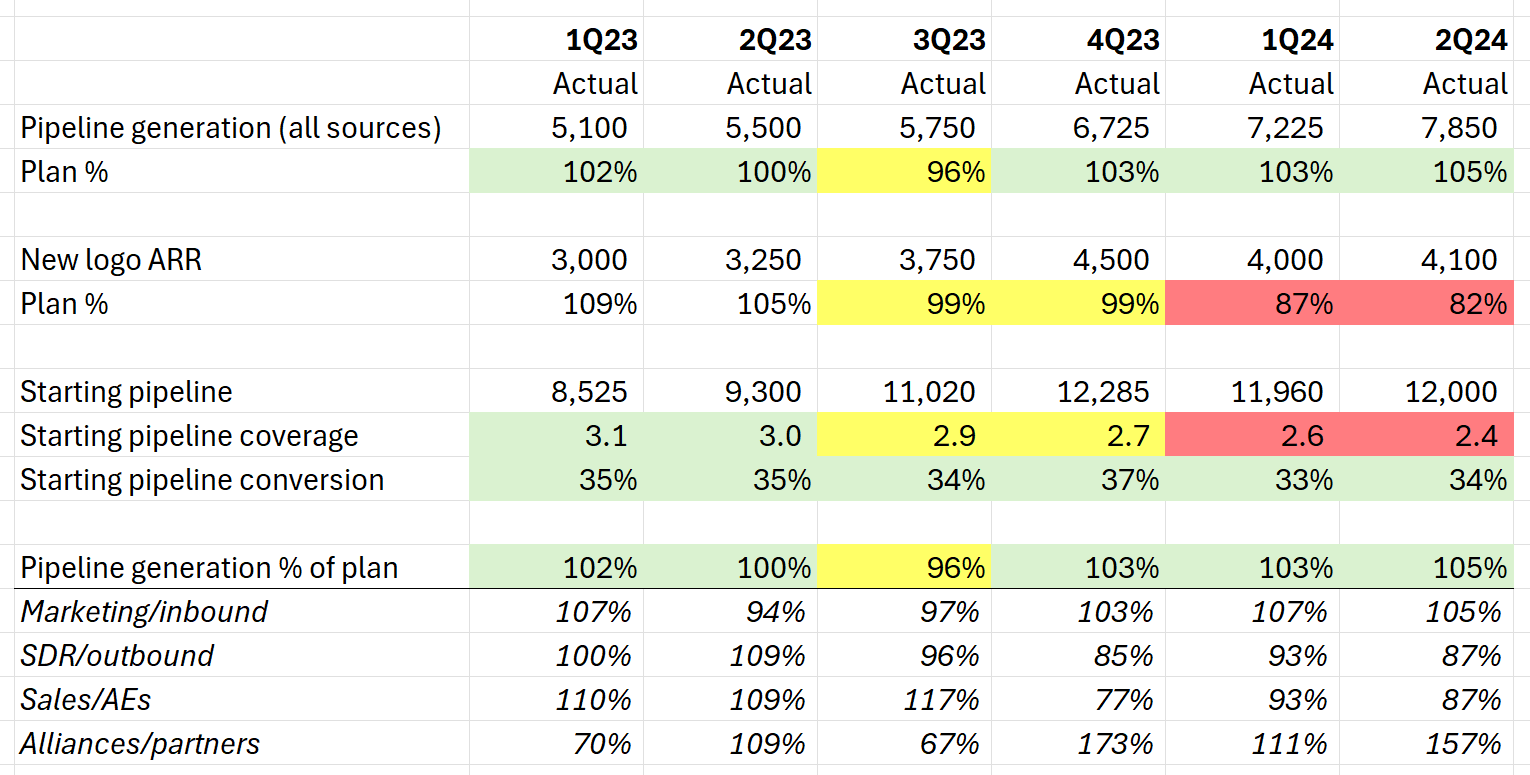
The first block shows that the company, with one small exception, is generally delivering on its pipegen targets and that they hit 105% of plan last quarter.
The second block shows that our friends in sales are struggling. Sales performance has consistently decreased for the past six quarters, from beating plan with 109% to coming up well short at 82%.
The third block shows that while pipeline conversion has been pretty stable at around 34%, starting pipeline coverage has been steadily deteriorating from 3.1x to 2.4x. Most companies can't make plan when starting with 2.4x coverage. It's clear that we have a starting pipeline problem.
But the fourth block shows that while the performance across pipeline sources is somewhat varied, that we don't have an overall pipegen problem. While SDRs and sales are struggling, their contributions are a small part of the mix (10% each) and the gap is more than offset by above-target contributions from marketing and alliances. Moreover, because alliances pipeline usually converts at a higher rate than SDR- or sales-generated pipeline, the mix change should impact yield favorably.
So, what the heck is happening? How are we consistently beating our pipegen targets, but consistently behind on starting pipeline? Three thoughts come to mind:
- Our model is wrong. We built a model for pipeline generation targets that relied on assumptions about win, loss, and slip rates as well as pipepline expansion and shrinkage. Somewhere that model is deviating enough from reality that we are hitting pipegen goals but missing starting pipeline coverage goals. Maybe we made mistakes in the first place or maybe reality has drifted away from that model. But let's remember that God didn't send us the model on stone worksheets and that hitting model-driven targets is not the point. Generating sufficient pipeline coverage is.
- The most common reasons for model drift are decreased win rates, increased average sales cycles, and decreased average deal sizes. But here we're seeing healthy and consistent week 3 pipeline conversion which makes me want to look elsewhere for an explanation.
- This is actually a tricky situation to diagnose. We're hitting increased pipegen targets, but starting pipeline is flat. The normal diagnosis would be increased loss and/or slip rates, but starting pipeline conversion is both healthy and consistent. Hum. This leads me to think that timing is off -- while we're generating the right amount of pipeline, not enough of it is landing in next quarter, suggesting that buying timeframes may have lengthened. This is one reason why I care so much about pipeline segmented by timeframe and not just rolling four quarters or all-quarters (aka tantalizing) pipeline.
Back to our main argument: the point of the entire pipegen machine is not to beat model-driven pipegen targets. It's to give a sales a chance to make the number each quarter. And that is far better measured by starting pipeline coverage than by pipeline generation. And that's why great marketers look starting pipeline coverage first and then pipeline generation after that.
Good marketers say, "I hit my marketing pipegen goals. Go me!" Great marketers say, "We helped tee-up sales for success this quarter. Go us!"
And the best marketers don't think their work is done at stage 2 -- they know there's plenty marketing can do both to increase close rates down the funnel and expansion in the bow tie thereafter.
But that's the subject of another post.