Please Don’t Scare the Children: Thoughts on a Delicate Reason to Split Off the New Business Team
Salespeople run on emotion. Bruising renewal conversations can erode the conviction they need to win new business. A delicate reason to separate land from expand and renew—and why confronting the brutal facts doesn’t require everyone to take the same daily beating.


I'm not generally one to be paternalistic in how we treat our employees. My mantra's closer to: "We're all adults here, folks." But we're also all humans here, folks. In today's post, we'll have a delicate conversation about why you might want to split your new business sales team from your expansion and renewals teams.
I’m sure your company has spent plenty of time discussing who owns what across land, expand, and renew. You’ve probably approached it from first principles, learned from recent experience, and compared notes with peers about how they do things. But, in all this discussion, did you consider the emotional toll of account management on your new-business salespeople? Because if you haven’t, you should.
Consider this post from OnlyCFO:
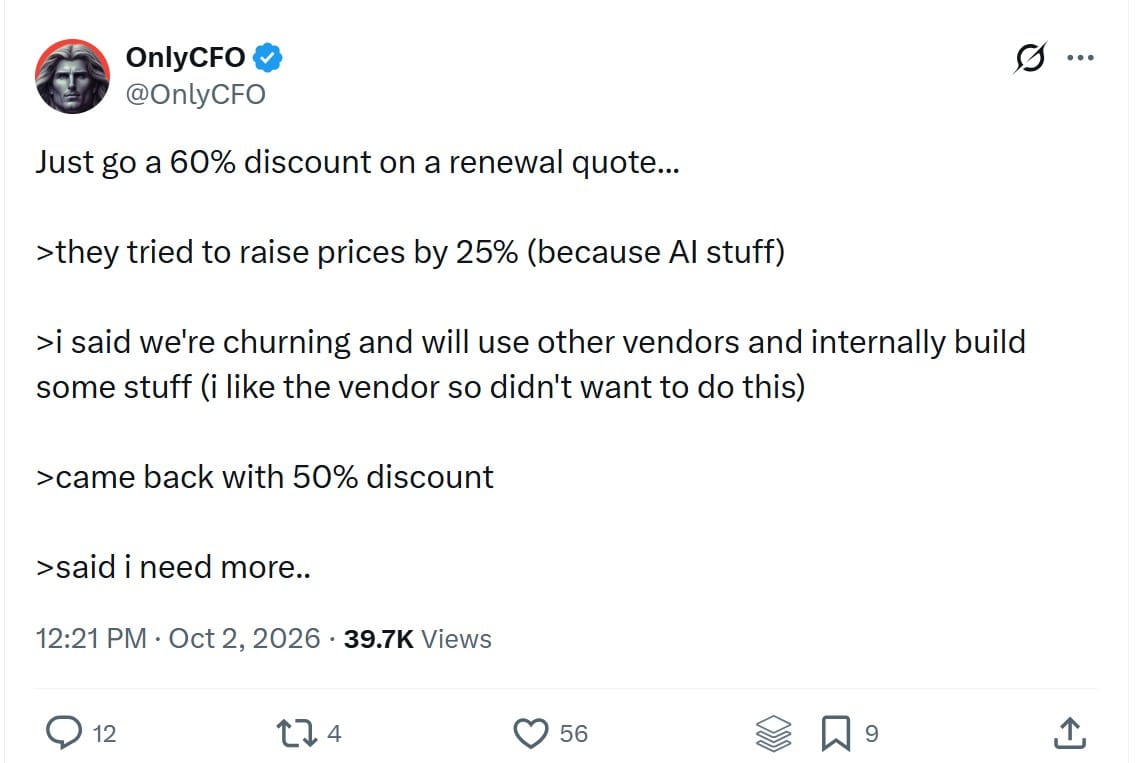
Baby, it's cold out there in renewals-land, particularly in traditional SaaS applications. And our friend OnlyCFO did this to a vendor he liked. I'd hate to see what he does to those he doesn't.
Now imagine being the salesperson handling that conversation. At 10:00, they're preaching the product’s value to a hot prospect. At 11:00, an existing customer says they can replace the product with another vendor and some agents they’ll build themselves. At 1:00, a different customer tells them that they loved the product, but they're not renewing at all – for budget and value reasons. The seller's phone rings at 3:00 with a call from yet another account and they're afraid to answer it.
How stoked do you think they're going to be for their 4:00 call with a new prospect?
It’s a bruising time to do renewals and expansion sales in traditional SaaS. Expansions, too? Yes. Particularly if you're in stop-the-bleeding mode. Think: we're not renewing at 100 units, more like 60. Oh, you've got some new agentic product? Great, we'll renew at 80 units. You saved the account and wiped out 20 units of would-be churn, but you're still driving 80% NRR, not 105% or 110%. Nobody's going to be very happy about that.
Salespeople run on emotion. They need to believe in their product, their company, and their ability to win. That belief affects how they prospect, present, handle objections, and negotiate. If you’re kidney-punching them three times a day, you’re going to suck the life out of them. Their productivity will suffer along with their spirit. They may quit or they may not. But either way, they're going to sell less.
Many things can make post-sales account management hard.
- You've got a new product and aren't good at deploying it. People love the idea, but they can't get it going.
- You're selling so much that you're way behind on deployments. Your organization is out of balance because you overstaffed sales relative to deployment capacity and are paying the price.
- You had a great vision, but the product – well – doesn't actually work, so the phones are lighting up. Support's on fire and collections have slowed to a trickle.
- A new alternative has arrived in the market, whether driven by an industry trend that might superannuate your category (e.g., AI) or simply in the form of a "free" product from a large platform vendor (e.g., Power BI, Unity Catalog).
Yes, you need to fix the underlying problem. If you launched a bad product, then fix the product. If customers aren’t getting value, figure out why and address it. If your pricing has become indefensible, deal with that. If the threat of AI is eating your lunch, build a credible response in both your product and story. Separating the sales and account management roles won’t fix any of those problems. That's not the question.
The question is what to do with your new business salesforce while you’re fixing them.
Even if you’d normally have AEs retain ownership of their accounts, this might be a good time to put them in pure land mode until further notice. Let them find and close new customers while other people handle expansion and renewals. Give those people the resources and management support to do the job.
So, Dave, you want the new-business salespeople blissfully ignorant of what happens after they sell?
A little shielded from how rough things are on the other side of the wall? Yes. That’s the delicate part of this argument. I don’t want them afraid to answer the phone. I want them excited to talk to the next prospect.
Besides, the wall will be porous. They’ll talk to their colleagues. Some customers will call them anyway. They’ll know there are problems, and they’ll need to believe you’re fixing them. But knowing about those problems is different from personally absorbing live customer frustration several times a day.
Salespeople are accustomed to rejection. Hearing “we’re not interested” from a prospect comes with the territory. Hearing “this doesn’t work” from someone who trusted your recommendation and bought the product is a different experience. So is hearing that a longtime customer now thinks your entire category is unnecessary. Enough of those conversations can undermine the conviction you need to sell.
Of course, reps still need to understand the product’s limitations and set appropriate expectations. If they’re creating the problems by overselling, fix that, too. Handing off the account doesn’t excuse making promises the company can’t keep.
I’m all for confronting the brutal facts. Stockdale paradox and all that. Management needs to understand what’s happening with customers and take responsibility for fixing it. But I don’t think confronting reality requires our new-business salespeople to get kidney-punched three times a day. We need to consider what that’s doing to their ability to sell.
And what about the people who handle expansion and renewals? They’re humans, too. Hopefully, they're cut from a different cloth: people who find satisfaction in turning around difficult accounts. And they need support, e.g., executives willing to join difficult conversations, and actual progress on the problems customers are raising. More than anything, they need realistic goals: saving an account at 80 units is not a huge failure when they told us six months ago they weren't renewing. In fact, it's a win. Or, if you view them like relief pitchers in baseball, it's a "save." Either way, it should be celebrated.
Yes, the NRR might only be 80%. But 80% is a lot more than zero. This is why I think these people should be comped relative to a realistic NRR target for the accounts they’ve been given. Otherwise, you end up in what I call “the customer success paradox.” You give your hardest accounts to your best people, who end up delivering the worst NRR. It’s like a diving competition where you forgot to factor degree of difficulty into the scoring.
When you revisit who owns what across land, expand, and renew, consider both the work and its emotional toll on the people who do it. You want new-business sellers who are excited to talk to prospects and account managers who see a hard-fought save as an accomplishment. Your role assignments, goals, and compensation plans should support both.
Fix the underlying problems, of course. But in the meantime, give people jobs they can succeed in and recognize success in the context of the accounts they’re handling. You don’t have to be paternalistic to acknowledge that how people feel about their work affects how well they do it. We’re all adults here, folks. But we’re also all humans.