
The One Thing That Everyone May Be Too Busy to Worry About: Winning
Everyone on the executive team is busy making plan and improving efficiency. But who is making sure you’re actually winning the market? Why CEOs need to track market share — even when the data is imperfect.


I know this sounds crazy, but quick: tell me who’s responsible in your organization for making sure the company is winning in the market.
- VP of sales? They’re losing sleep over the new bookings plan.
- VP of marketing? They’re obsessing over pipeline.
- Head of customer success? They’re fretting about GRR, NRR, or both, depending on how you’ve defined the job.
- Head of product? They’re worried about whether they got the requirements right and whether engineering is going to ship on time.
- CFO? They’re worried about the operating plan, cash, and all the ways reality might depart from the spreadsheet.
- The investors on the board? They’re worried about how you’re tracking to the model they presented to their investment committee.
Everybody has something important to worry about. And everybody can get so focused on their own thing that nobody is watching the one thing that ultimately matters most:
Are we winning the market?
And it goes deeper. Because once you're achieving all those plan targets, the conversation immediately changes to efficiency:
- VP of sales: productivity and attainment, win rates, and sales cycle length.
- VP of marketing: pipe/spend, cost/oppty, and marketing attribution.
- Head of customer success: ARR/CSM, time-to-value, and COGS.
- Head of product: R&D spend, engineering velocity, roadmap predictability, and whether anyone is actually using what you ship.
- CFO: burn multiple, free cash flow, operating margins, and every major expense line as a percentage of revenue.
- The investors on the board: Rule of 40, burn multiple, ARR/FTE, and whether the whole machine is getting more efficient as it scales.
So now we have two layers of management attention: first, did we make the plan? Then, did we make it efficiently? That's usually enough to keep any executive leadership team (ELT) fully occupied and then some.
Both layers are important. But neither addresses our simple question:
Are we winning the market?
The problem is that virtually all those metrics are plan-relative. We're measuring ourselves against what we said we were going to do.
Plan-relative performance is endogenous: the target is determined partly from within the system itself. Management helps set and negotiate the plan, so performance against plan reflects not only how well you operated, but also how well you planned and negotiated.
If I negotiate an 80% growth plan and deliver 100%, I'm a hero. If you sign up for 120% and deliver 110%, you're explaining yourself at the board meeting — even though you grew faster than I did.
None of this means making plan isn't important. Making plan is one of the best indicators that management has control of the business. You can predict what's going to happen, make commitments based on those predictions, and then deliver. That's why I've long argued that you should make a plan that you can beat — not by sandbagging, but by building a realistic, aggressive plan and then executing against it.
But plan-relative measures are fundamentally inward-looking. They ask: are we doing better or worse than we said we would?
Enter benchmarking, you're thinking. That's outward-looking. We can compare ourselves to other companies, ideally ones like us.
How do other companies get a 14-month CAC payback period (CPP) when ours is 22? Why is their NRR 115% when ours is 103%? Why are they spending 18% of revenue on R&D when we’re spending 27%?
These are all great questions. I’m a big believer in benchmarking. Absent benchmarking, companies tend to compare themselves only to their own historical performance. Such comparisons usually produce annual, incremental gains. Tweak this. Improve that. And maybe you get 10% more productivity.
But when something is really off — like a CPP that’s 57% above benchmark — that’s when you need to sit down and challenge some key assumptions.
“I know we think we need an AE/SC ratio of 1:1, but can we get by at 2:1? What would have to change in the job duties or in how we approach POCs?"
That’s the real value of benchmarking. It doesn’t just tell you that you’re ahead or behind. It forces you to have hard conversations, challenge some deeply held assumptions, and take material risks in pursuit of non-incremental gains.
But benchmarking, while outward-looking, still just helps you run a tighter operational ship. It doesn't answer that nagging question:
Are we winning in the market?
You can go out of business, all while making plan and doing so efficiently. All it takes is an unambitious operating plan where you quietly lose market share every quarter. Compound that over 12 to 16 quarters and boom: you go from a contender to a nobody.
Did you notice what I did there? I snuck in a metric: market share.
Every company should aim to be the market-share leader in its chosen market. So if you want to know if you're winning, you need to start tracking market share.
How I Tracked Winning at Business Objects
I think this is the most important chart I ever made in my career. This version is from the 2002 Business Objects sales kickoff, though we tracked it every quarter and discussed it at our quarterly business reviews.
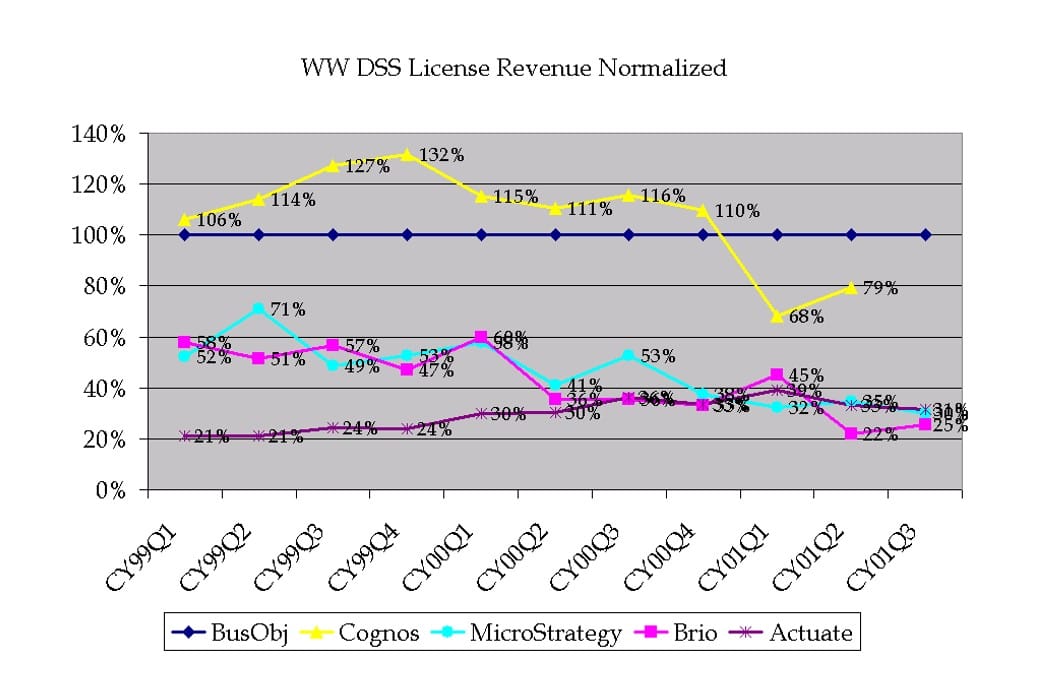
It's a strange chart. It shows each major competitor's quarterly revenue divided by ours (aka, relative market share). So we were definitionally always 1.0, a flat line. Boring, you might think, because our line never moves.
Ah, but what's interesting is how the other lines move relative to ours. Anyone moving up is gaining relative market share; anyone moving down is losing it.
See how Cognos starts out ahead of us in 1Q99 and increases its lead through 4Q99, going from 106% to 132% of our revenue? See how big MicroStrategy (yes, that MicroStrategy) was back then, peaking at 71% of our revenue in 2Q99? See how Actuate, though much smaller, steadily gained on us for several quarters, moving from 21% to around 40%?
That's why I loved this chart. It didn't tell us whether we were making plan. It told us whether we were winning.
And, trust me, it didn't win me any popularity contests. If you were running a region that had just beaten plan, the last thing you wanted was the CMO showing up with the regional version of the chart and saying, "Nice quarter. Unfortunately, you're losing market share."
But that was precisely the conversation we needed to have.
Who and How to Track This Today?
This leaves us with two key questions:
- Who should track this today?
- How can you track this today?
Personally, I think a great, holistic CMO — what Stephanie Buscemi recently called an "orchestration" CMO — should track this. I've always believed in Peter Drucker's view of marketing as the whole business seen from the customer's point of view. If you have that kind of CMO, they should want to know whether you're winning the market. I'd expect them to track it eagerly.
If, on the other hand, you have a more demand-gen-oriented CMO who's primarily focused on pipeline, or a more brand-oriented CMO who's primarily focused on awareness and reputation, then you may need to track this yourself as CEO.
But somebody needs to track it. Not doing so is the corporate equivalent of burying your head in the sand. You can make plan, improve efficiency, run great QBRs, and have absolutely no idea that a competitor is steadily taking relative market share.
How to Track Market Share Today
This was easier back in the day. Software companies went public at relatively small sizes and disclosed revenue — often with geographic breakouts — so you could build a pretty good model of who was gaining and losing share.
But even before our competitors were public at Business Objects, we tracked it. We maintained a master spreadsheet with our best estimate for each competitor and the data points behind it. One source implied $100M, another $120M, another $110M. Fine. Triangulate, document the logic, and move on.
You can still do that today. Headcount used to be a decent proxy for ARR in SaaS, though AI companies have made that less reliable. So collect whatever credible signals you can find: stated or rumored ARR, customer counts, headcount, sales hiring, management comments, recruiter chatter — whatever helps.
Then triangulate.
Just make sure everyone understands these are estimates. The point isn’t to argue whether Competitor X is at $92M or $97M. It’s to know whether they’re roughly $50M, $100M, or $200M — and whether they’re gaining on you or falling behind.
Then Track the Competitive Battle Deal by Deal
There's a second, more granular level of analysis that complements the market-share model. (This is a bit of aside, but I think it's important.)
Your CRM can already tell you:
- How often does competitor X appear in our deals?
- What's our win rate against them?
- How does that vary by segment, geography, product, or use case?
- Are they appearing more or less frequently over time?
For answers to deeper questions – e.g., why do we win, why do we lose – I've always liked third-party win/loss analysis.
This is all useful. But the question I'd really like answered is the inverse:
Of competitor X's deals, how many are we in?
That's a much harder question because, inconveniently, you don't have access to their Salesforce instance. Nor should you try to get it. You don't need to go dumpster diving to solve this problem.
But there are increasingly good ways to triangulate. G2 Buyer Intent, 6sense, and Demandbase can help identify accounts researching competitors. So take the universe of accounts apparently looking at Competitor X and ask: how many of those accounts are we talking to? That's not perfect, but it starts to answer the question your CRM can't.
Technographic and installed-base data can provide another angle. HG Insights, for example, explicitly analyzes competitor penetration and installation counts. Custom market research projects can help you find out, too – and they're not that expensive (e.g, $50K).
Finally, you can use conversation intelligence tools, like Gong, to get a view of your competitive landscape.
Conclusion
Let's wrap this up.
The normal machinery of running a company will keep you intensely focused on making plan. Board meetings, QBRs, operating reviews, and functional metrics will see to that. Once you’re making plan, benchmarking and efficiency metrics will push you to run the machine better. Endlessly.
All of that matters. None of it tells you if you’re winning.
That’s the trap. You can get so busy making plan, improving efficiency, and benchmarking against peers that nobody looks up to see whether a competitor is steadily taking the market away from you. You may have a feeling about it from headcount data, funding announcements, or customer wins, but nobody is trying to quantify it.
So somebody needs to own that. Ideally, you've hired a great CMO and they track it. But ultimately, as CEO, you own it. Don't let everyone get too busy to ask the one question that matters most:
Are we winning in the market?