
Book Review: The Curious Case of Mike Lynch by Katie Prescott
Katie Prescott’s biography of Mike Lynch is a compelling read with particular relevance in today’s AI boom. My review explores the danger of sustaining an aura of success, the difference between loyalty and truth, and the questions I wish the book had pressed harder.

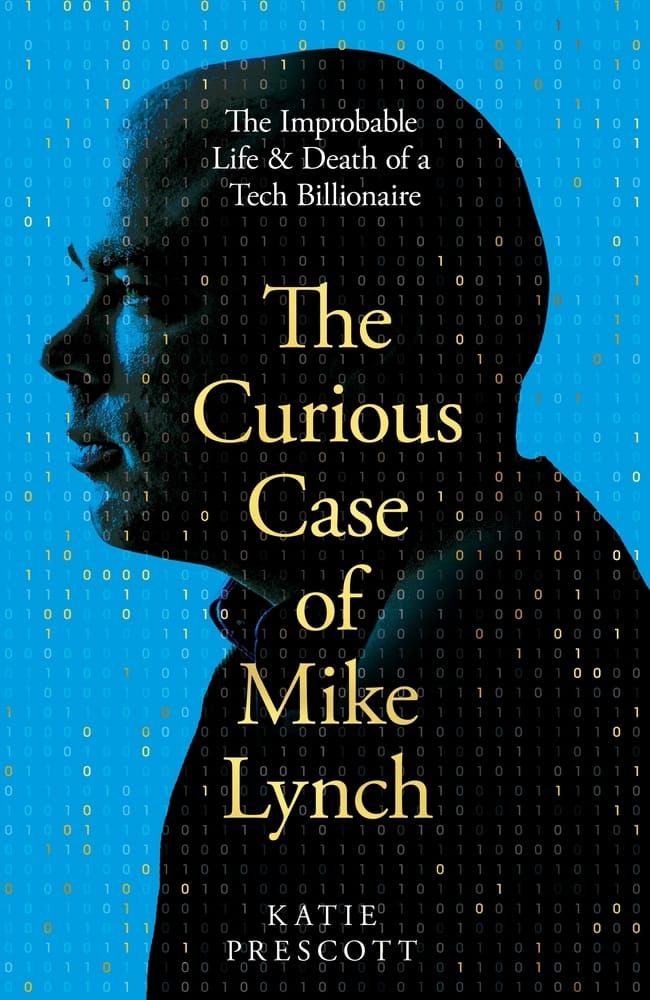
We're in the middle of an AI boom. Capital is abundant, expectations are high, and nearly every company is trying to position itself as a winner in the coming transformation. Amid all the excitement, a basic challenge remains: separating what exists today from what might exist tomorrow. Customers, employees, journalists, investors, and boards are all trying to answer the same question: what's real, what's aspirational, and what's simply marketing?
That makes now an unusually good time to read Katie Prescott's The Curious Case of Mike Lynch: The Improbable Life and Death of a Tech Billionaire.
While the technologies are different, the book explores a timeless question: what happens when exceptionally smart people become committed not merely to success itself, but also to sustaining the aura of success?
Published in 2025, the 464-page book tells the remarkable story of Mike Lynch, founder of Autonomy, once Britain's most successful software entrepreneur. Prescott, technology business editor at The Times, became fascinated by the Autonomy saga while covering it as a journalist and eventually decided to write the book. The result is a highly readable biography that succeeds in making both Lynch and the surrounding drama accessible to readers who may know little about either.
Before diving in, I should disclose that I've never been a fan of either Autonomy or Lynch. During my time as CEO of MarkLogic, we competed against them in some deals. I hired several Autonomy alumni and knew people from prior jobs who ended up in relatively senior positions at the company. So, my perspective comes from having observed Autonomy as a competitor and from following the story through friends and colleagues for many years.
I met Lynch once during a discussion about a potential strategic partnership. Nothing came of it. What surprised me most was how little interest he seemed to have in our technology. MarkLogic's technology was pretty remarkable at the time, yet Lynch seemed far more interested in the business. Perhaps that was because our technology wasn't Bayesian. Perhaps it was because he had already become more interested in building companies than building technology. Or perhaps, lacking our founder in the meeting, he simply concluded that we weren't smart enough to explain it properly. Whatever the reason, I left with the impression that I had spoken less to the brilliant computer scientist I'd expected and more to yet another businessman.
For readers unfamiliar with the story, Lynch founded Autonomy in Cambridge in 1996 and built it into one of Europe's most successful software companies. In 2011, HP acquired Autonomy for roughly $11 billion. A year later, HP wrote down most of the acquisition's value and alleged it had been misled about Autonomy's financial performance.
What followed was a saga that lasted more than a decade: civil litigation, criminal prosecutions, extradition battles, accounting controversies, witness cooperation agreements, jury trials, and endless public debate. Lynch was ultimately acquitted by a US jury in 2024, only to die weeks later when his superyacht, the Bayesian, sank off the coast of Sicily.
Prescott excels at biography. By the end of the book, readers know Lynch well: the brilliant Cambridge academic, the obsessive technologist, the eccentric billionaire, the relentless competitor, the difficult boss, the loyal friend, the dog lover, the collector of unusual properties, and the larger-than-life personality who inspired extraordinary devotion among colleagues and employees. Whatever one thinks of Lynch, Prescott succeeds in making him vividly human.
The book is equally strong in explaining why Lynch mattered. Many Americans have never heard of him. For a generation of British entrepreneurs, however, he represented something important: proof that a globally significant software company could be built outside Silicon Valley. Lynch wasn't merely a successful founder. He was a symbol. One senses throughout the book that the stakes eventually became larger than Autonomy itself.
Prescott also deserves credit for making a highly technical story readable. Revenue recognition, reseller transactions, accounting standards, extradition proceedings, and civil litigation do not naturally lend themselves to compelling narrative. Yet the book remains engaging throughout.
The biggest thing I took away from the book, however, had little to do with accounting. It had to do with success — or, more precisely, the aura of success.
I've long believed that, at least in Silicon Valley-style companies, corporate scandals are rarely about money in the narrow sense. Sure, there is plenty of money involved. But the money isn't really the point. The point is an all-consuming desire to be seen as winning: to build and sustain an aura of success around a company that becomes self-reinforcing.
Why'd you buy from XYZco? Because they're the leader. How do you know they're the leader? Because they're growing fastest. Because they've raised the most money. Because they did that publicity stunt. Because their CEO is on all the conference stages. Because they've got the best strategy. How do you know it's the best strategy? Because they're growing the fastest. Because they're the market leader.
Eventually the reasoning becomes circular.
Success attracts customers, employees, investors, journalists, partners, and more success. Customers buy because other customers are buying. Employees join because other employees want to join. Investors invest because other investors are investing. The company starts selling two products: its actual product and the story of its success.
The danger comes when preserving the aura becomes more important than the underlying reality. That observation leads me to two reservations about the book.
The first concerns loyalty.
Throughout the narrative, people are frequently described in terms of loyalty, betrayal, friendship, and allegiance. Witnesses "turn." Former colleagues "stand by" Lynch. Others remain loyal despite enormous pressure.
These are understandable ways to describe events, but I found myself repeatedly wanting the book to step outside Lynch's point of view and ask a different question: not who remained loyal, but who was right.
One passage describes Stouffer Egan's cooperation with prosecutors as an act of betrayal. But betrayal is a curious word. If Egan was lying to save himself, it would fit perfectly. If he was telling the truth, it would become much harder to justify.
This distinction matters because loyalty and truth are not the same thing. If someone testifies truthfully about misconduct, is that disloyalty or integrity? Conversely, if someone refuses to provide damaging evidence, is that loyalty or something else entirely?
The answer depends on what actually happened and whose point of view you adopt. Yet when the media discuss corporate scandals they routinely adopt the language of the accused. The discussion quietly shifts from the pursuit of truth to the perspective of the accused.
My second reservation is more significant and concerns what struck me as an under-explored inconsistency at the heart of the story.
Prescott repeatedly portrays Lynch as brilliant, intensely competitive, deeply involved, extraordinarily persuasive, detail-oriented, and at times controlling. Former colleagues describe being mesmerized by him. The book paints a picture of a founder who exerted enormous influence over both the company and the people around him. More than once, witnesses describe people being "under his spell." Even some who later testified against him continued to speak admiringly of his intellect and force of personality.
At the same time, the book describes allegations involving backdated contracts, reseller transactions, side agreements, misleading emails, unusual hardware transactions, and other efforts allegedly designed to sustain reported growth and hit quarterly targets.
What surprised me was not that these allegations existed. It was how little time the book spends reconciling them with the portrait it paints of Lynch.
The book seems to ask readers to accept two propositions simultaneously. First, that Lynch was brilliant, intensely involved in the business, obsessed with performance, frustrated by Wall Street's expectations, and capable of drilling into remarkable levels of detail. Second, that practices allegedly occurring repeatedly over multiple years somehow escaped the attention of a man portrayed as obsessively focused on the very metrics they affected.
Perhaps both propositions are true. But the more convincing the book becomes on the first point, the harder it becomes not to question the second. Reading the book, I was reminded of the famous courtroom scene in A Few Good Men (edited for brevity).
Kaffee: A moment ago, you said that you ordered Lt. Kendrick to tell his men that Santiago wasn't to be touched.
Jessup: That's right.
Kaffee: And Lt. Kendrick was clear on what you wanted?
Jessup: Crystal.
Kaffee: Any chance Lt. Kendrick ignored the order?
Jessup: Ignored the order?
Kaffee: Any chance he forgot about it?
Jessup: No.
Kaffee: When Lt. Kendrick spoke to the platoon and ordered them not to touch Santiago, any chance they ignored him?
Jessup: We follow orders, son. We follow orders or people die. It's that simple. Are we clear?
Kaffee: Crystal. Colonel, I just have one more question ... if you gave an order that Santiago wasn't to be touched, and your orders are always followed, then why would Santiago be in danger? Why would it be necessary to transfer him off the base?
I found myself asking a similar question while reading about Autonomy.
If Lynch was as brilliant, detail-oriented, involved, and controlling as the book convincingly portrays him to be, how exactly are readers meant to reconcile that with the degree of ignorance his defense appears to require?
To be fair, this issue was explored at trial. Witnesses were pressed on what Lynch knew, when he knew it, and whether they could place him in specific discussions or transactions. The defense argued that Lynch focused on technology, strategy, and the business while delegating finance and accounting matters to others, particularly CFO Sushovan Hussain. That debate was clearly part of the case. What I found under-explored, however, was the broader tension between the portrait of Lynch presented throughout the book — brilliant, deeply involved, intensely competitive, obsessed with results, and capable of exerting enormous influence over the organization — and the degree of ignorance that defense appears to require. That's not primarily a legal question. But I finished the book wishing Prescott had spent more time wrestling with it.
And even if one resolves that inconsistency in Lynch's favor, a second question remains: where did the pressure come from? One of the recurring themes in the testimony is pressure — pressure to make the quarter, pressure to hit the numbers, pressure to sustain growth, pressure to avoid disappointment. Witnesses repeatedly described an organization focused on maintaining the narrative of relentless success. If Lynch was the dominant force inside Autonomy — as Prescott persuasively argues throughout the book — then surely it is worth asking what role he played in creating that environment.
I've seen versions of this story before. Different companies, different industries, different outcomes. But the pattern is familiar. Smart people become trapped by the need to sustain the appearance of success. Eventually the signal can become more important than the reality. When that happens, customers buy from the wrong vendors, employees join the wrong companies, investors allocate capital to the wrong opportunities, and competitors lose deals they should have won. Fraud becomes rust on the flywheel of the tech ecosystem — not just because of the money lost, but because of the trust destroyed.
Despite my criticisms, I strongly recommend the book. Prescott has written a compelling account of one of the most consequential and controversial figures in European software history. She succeeds brilliantly in helping us understand why so many people admired Mike Lynch.
I only wish she had spent a bit more time wrestling with the questions that still linger once the admiration fades.