The Kellblog Companion and Thoughts on Derivative Works
Introducing the Kellblog Companion, a new way to explore decades of posts by topic. Plus, why AI has changed my thinking about derivative works: the goal isn’t to recover lost traffic. It’s to keep reaching people.

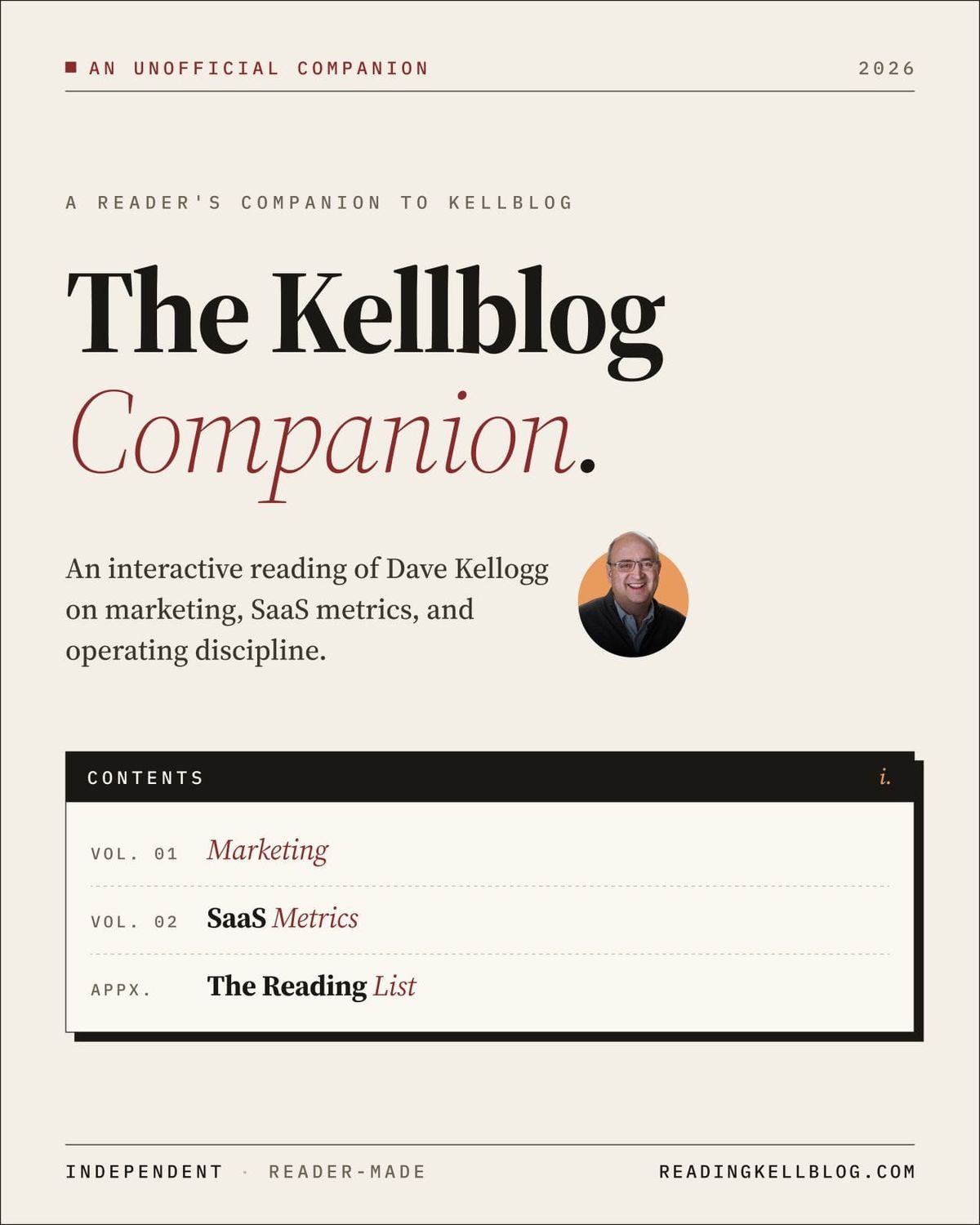
Today I'm pleased to introduce the Kellblog Companion, a new way to explore Kellblog created by Saurav Chowdhury. It reorganizes decades of posts into a structured knowledge base that's easier to browse by topic, easier to search, and easier to use when you're trying to answer a particular question.
If you've ever thought, "I know Dave wrote about this, but I can't find it," you'll probably find it useful. Note that while Kellblog already offers a search engine, categories (e.g., pipeline), and a best-of page, those only help you navigate the existing, post-based structure. The Companion presents the information into a more topical, browsable form. It feels a bit like transforming the blog into a not-dry textbook, if such a thing exists.
Check it out!
I'd like to thank Saurav both for building it and for asking me first. By asking before investing a lot of time, we had a chance to discuss the idea and make sure we were both comfortable with what he was doing -- before he did it. (And yes, because the Kellblog license prohibits derivative works, asking first also neatly resolved the legal question.)
Saurav isn't alone. Over the past months, a surprising number of people have built derivative and/or complementary works [1] on Kellblog. Someone independently built a Dave Kellogg GPT, which I've since linked to the site. (Several companies I advise have built internal-use Dave-GPTs. So now, when someone at one of those companies asks me a question, I have to preface my response with, "What did the internal GPT-me say?" to avoid contradicting myself.) A technical marketer built a support chatbot but ended up changing jobs, and out of my orbit, before I could figure out how to integrate it. Most recently, Fluint co-founder Nate Nasralla created an excellent guide for early-career enterprise sellers that curates ten Kellblog posts, adds his own commentary, and explains why he thinks they're worth reading.
Collectively, these projects made me rethink something I'd rarely considered before: what role derivative works should play in the AI era.
We all know that AI is fundamentally changing how people find and consume information. Like most publishers, my web traffic has taken a material hit because LLMs (e.g., ChatGPT, Claude) increasingly answer questions directly instead of sending readers to the original source. In effect, they are front-running publishers.
For example:
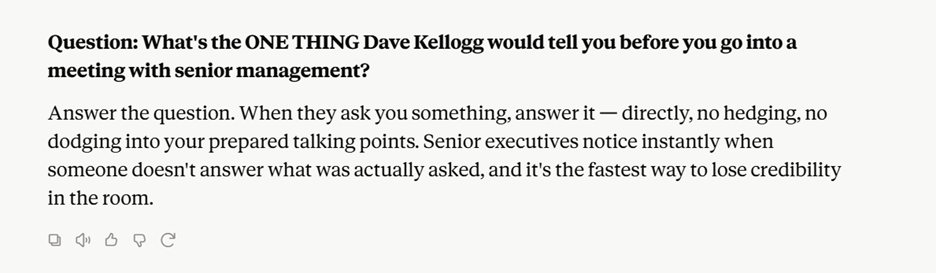
Claude provides the correct answer, but this output generates no Kellblog traffic [2]. Heck, it doesn’t even have a link.
Fortunately, Kellblog was never about monetization. It was always about sharing what I had learned (usually, due to my nature, the hard way). The point was to pay it forward. To the extent there was a monetization strategy, it was some combination of good karma [3] and brand building.
So, do I think my ideas aren’t getting out there as much because my traffic is down? No. But that’s anecdotal. I can’t easily measure it [4]. I’m still operating on the same leap of faith that led me to start writing the blog in the first place. Kellblog has always been a message in a bottle.
While I keep up on AEO fundamentals [5], I have no interest in becoming an AEO expert. I considered creating online courses. I thought about turning Kellblog into a book (until I discovered David Politis had already beaten me to it with the excellent Startup Survival Guide). But the question was never, "How do I get my lost traffic back?" It was, "How do I continue to reach people in an AI-first world?"
My first answer was to change publishing platforms, moving from WordPress and a twenty-year-old unsupported theme to Ghost. Responsive design, native newsletter support, a simpler editor, and a cleaner tagging system weren't about chasing AI — they were simply about getting out of my own way.
My second answer was to become more supportive of people building on Kellblog. Heck, if I didn't want to turn the content into a book [6], why not let Saurav transform it into something book-like? Why not let someone build a support chatbot or a custom GPT (though I still plan to build my own at some point)? Collectively, the community can experiment much faster than I can, so why not leverage that? So, here's my new default answer: if you want to build something bigger or more specific using my content, and it's both noncommercial and freely available to the community, I'm going to try to find a way to say yes.
That doesn't mean a permanent blanket permission. It means my default posture has changed. You have an idea? Ask. Chances are I'll say yes. Just don't try to monetize my content (noncommercial), make sure to credit me (attribution), and don't put so much into the project that you'll be in trouble if I ever have to revoke my permission. That's my new philosophy.
Notes
[1] The legal rabbit hole gets deep fast. My own view is that the Kellblog Companion and the support bot are derivative works that require my permission under the Creative Commons license, while Nate's reading guide is commentary about Kellblog rather than a derivative work.
[2] This would be devastating if I were trying to monetize my site through advertising. Even worse, if I had to pay journalists to write it.
[3] Thanks to people like Andy, Christian, and Christopher.
[4] Thank goodness I’m not a CMO who has to. Tools do exist of course, but for a solo blogger, they’re neither easy nor comprehensive.
[5] As I’ve always done with SEO fundamentals. Talk to me about canonical tags.
[6] Doing that the traditional way would have cost roughly $40K, plus a lot of time.