Why Every Startup Needs an Inverted Demand Generation Funnel, Part II
In the previous post, I introduced the idea of an inverted demand generation (demandgen) funnel which we can use to calculate a marketing demandgen budget based given a sales target, an average sales price (ASP), and a set of conversion rates along the funnel. This is a handy tool, isn't hard to make, and will force you into the very good habit of measuring (and presumably improving) a set of conversion rates along your demand funnel.
In the previous post, as a simplifying assumption, we assumed a steady-state situation where a company had a $2M new ARR target every quarter. The steady-state assumption allowed us to ignore two very real factors that we are going to address today:
- Time. There are two phase-lags along the funnel. MQLs might take a quarter to turn into SALs and SALs might take two quarters to turn into closed deals. So any MQL we generate now won't likely become a closed deal until 3 quarters from now.
- Growth. No SaaS company wants to operate at steady state; sales targets go up every year. Thus if we generate only enough MQLs to hit this-quarter's target we will invariably come up short because those MQLs are working to support a (presumably larger) target 3 quarters in the future.
In order to solve these problems we will start with the inverted funnel model from the previous post and do three things:
- Quarter-ize it. Instead of just showing one steady-state quarter (or a single year), we are going to stretch the model out across quarters.
- Phase shift it. If SALs take two quarters to close and MQLs take 1 quarter to become SALS we will reflect this in the model, by saying 4Q20 deals need come from SALs generated in 2Q20 which in turn come from MQLs generated in 1Q20.
- Extend it. Because of the three-quarter phase shift, the vast majority of the MQLs we'll be generating 2020 are actually to support 2021 business, so we need to extend the model in 2021 (with a growth assumption) in order to determine how big of a business we need to support.
Here's what the model looks like when you do this:
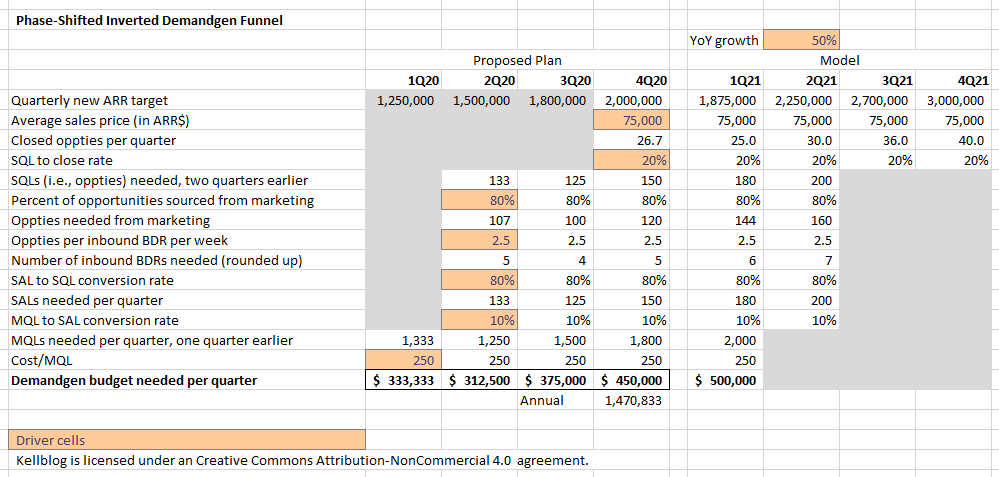
You can see that this model generates a varying demandgen budget based on the future sales targets and if you play with the drivers, you can see the impact of growth. At 50% new ARR growth, we need a $1.47M demandgen budget in 2020, at 0% we'd need $1.09M, and at 100% we'd need $1.85M.
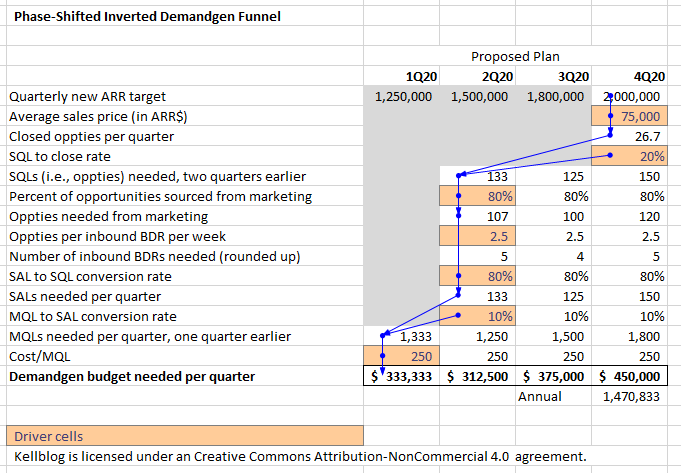
Rather than walk through the phase-shifting with words, let me activate Excel's trace-precedents feature so you can see how things flow:
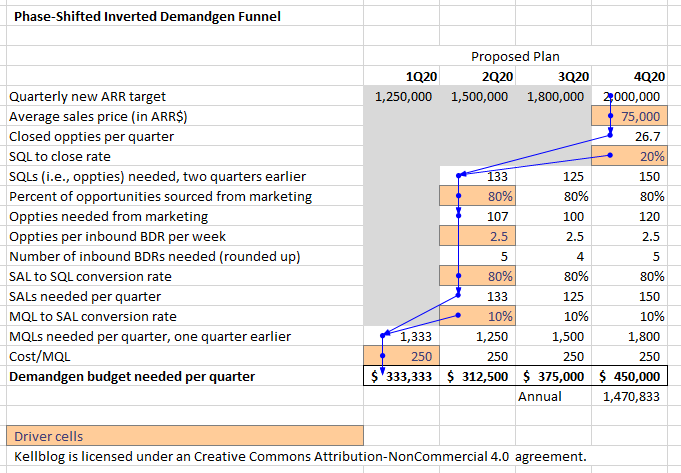
With these corrections, we have transformed the inverted funnel into a pretty realistic tool for modeling MQL requirements of the company's future growth plan.
Other Considerations
In reality, your business may consist of multiple funnels with different assumption sets.
- Partner-sourced deals are likely to have smaller deal sizes (due to margin given to the channel) but faster conversion timeframes and higher conversion rates. (Because we will learn about deals later in the cycle, hear only about the good ones, and the partner may expedite the evaluation process.)
- Upsell business will almost certainly have smaller deal sizes, faster conversion timeframes, and much higher conversion rates than business to entirely new customers.
- Corporate (or inside) sales is likely to have a materially different funnel from enterprise sales. Using a single funnel that averages the two might work, provided your mix isn't changing, but it is likely to leave corporate sales starving for opportunities (since they do much smaller deals, they need many more opportunities).
How many of these funnels you need is up to you. Because the model is particularly sensitive to deal size (given a constant set of conversion rates) I would say that if a certain type of business has a very different ASP from the main business, then it likely needs its own funnel. So instead of building one funnel that averages everything across your company, you might be three -- e.g.,
- A new business funnel
- An upsell funnel
- A channel funnel
In part III of this series, we'll discuss how to combine the idea of the inverted funnel with time-based close rates to create an even more accurate model of your demand funnel.
The spreadsheet I made for this series of posts is available here.